
Bottled water production: solve one problem
Why Is Your Water Filling Machine Producing Too Few Bottles?
A filler can run at its displayed speed and still deliver too few saleable bottles. Find where production time or acceptable bottles disappear before buying a faster monoblock.
Measure one bottle format over a fixed time window, then separate upstream starvation, filler or capper stops, downstream blockage and rejected bottles. The first event matters more than the machine that displays the last alarm.
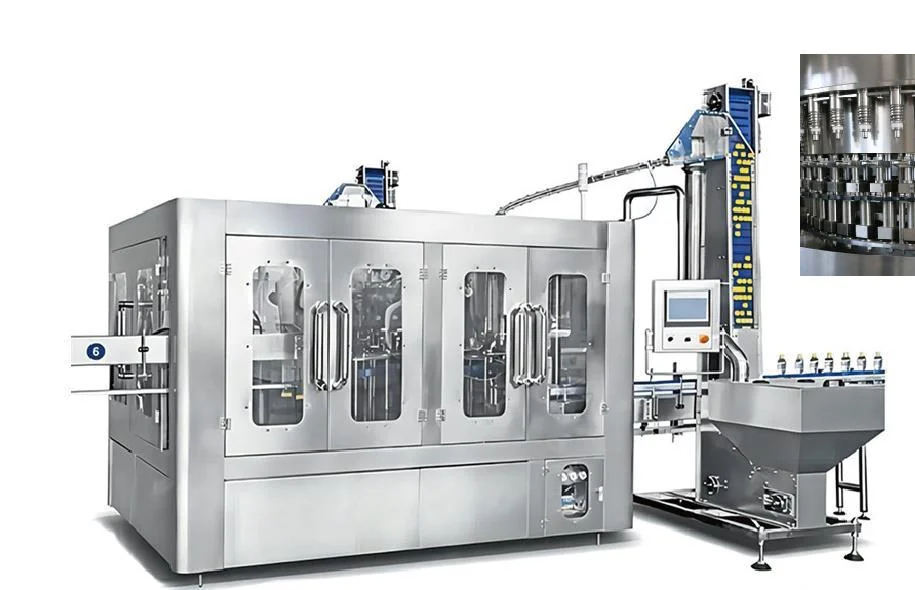
Compare good bottles over the same time window
Record the bottle volume, closure, finished pack, test duration and counting point. Keep rejects separate and avoid adding stops that overlap. A display showing instantaneous BPH is not a good-bottle shift total.
Illustrative arithmetic: 6,000 accepted bottles in 60 elapsed minutes means 6,000 good bottles/hour. If the same run contained 45 operating minutes, its operating-time rate is 8,000/hour. These denominators answer different questions; neither is an Allot Tech rating.
Use the first event to narrow the cause
A frequent alarm is a lead, not proof of root cause. A cap-supply stop may trigger later filler and conveyor alarms. Preserve the event order and ask the equipment owner to confirm the failed condition.
| Observed pattern | Evidence to collect | Scope to review |
|---|---|---|
| Empty spaces arrive before the filler slows | Bottle-infeed count, upstream stops and event timestamps | Bottle supply, transfer and accumulation |
| Filler stops while bottles and downstream space are available | First alarm, water-feed state and the affected bottle/closure format | Filler, cap supply or format-specific fault |
| Full bottles queue after the capper | First downstream stop and usable buffer occupancy | Labeler, packer and line-control handoffs |
| Machine counts rise but saleable output stays low | Separate rejects, held bottles and rework counts | Quality cause rather than speed alone |
Confirm a correction under controlled conditions
Do not bypass guards or increase feed pressure and machine speed from a generic web checklist. Hardware settings and interventions need the model manual and a qualified technician.
- 01
Use the same bottle, cap, label and pack revisions for the comparison.
- 02
Save the baseline good-bottle count, first-stop log and rejected quantity.
- 03
Have the responsible technician review one suspected cause using the machine manual and approved isolation procedure.
- 04
Retest after one documented change; record restart loss and the next stable counting window.
- 05
Accept the change only when good output improves without more rejects or a newly blocked downstream stage.
Decide whether the remedy is service, interfaces or new equipment
Repeated upstream shortage usually calls for a supply or transfer review. Persistent downstream blockage calls for pack-format capacity and control review. A confirmed format limitation inside the filler may justify parts, refurbishment or replacement. Compare these scopes against the measured loss, not only a nameplate speed.
- Machine model, serial number and existing line layout.
- Bottle and cap drawings, samples and format-change records.
- Target good bottles/hour and the exact counting boundary.
- Timed first-stop events, overlapping stops and restart rejects.
- Available upstream supply and downstream finished-pack rate.
- What the supplier must inspect, modify, supply and prove at acceptance.
Questions buyers ask
Will a faster filler solve low line output?
Only if the filler is the proven sustained constraint for the required format. Faster filling can worsen a packing queue when the downstream rate is lower.
What evidence should I send before requesting a replacement?
Send a timed good-bottle count, machine and package identification, first-stop sequence and reject data. This separates a machine limitation from supply, transfer, packing or quality losses.
Related troubleshooting guides
Water bottle shrink-pack problems
Water bottle shrink-pack problems →Cap leaks after capping
Cap leaks after capping →Wrinkled or skewed bottle labels
Wrinkled or skewed bottle labels →Ask Allot Tech to review the evidence
Send your machine identification, package drawing and timed observations. State what is unknown so the proposed scope follows the actual problem.