
Bottled water production: solve one problem
Water Bottle Cartons Opening After Sealing: Check the Closure at Each Handoff
A closed carton at machine discharge can reopen during the wait or the next transfer. An off-center flap, lifted tape and an adhesive joint that separates are different observations. None alone proves that a faster sealer or a stronger tape will resolve the actual failure.
Identify the approved filled case, closure route and first reopening time. Compare after forming/loading, after sealing and after the agreed wait/transfer using matched cases. Keep closure acceptance separate from bottle count, pallet stability and shipping qualification.
Define the filled carton and the observation age
Keep carton drawing and board lot, bottle arrangement, actual filled contents and approved tape or adhesive specification. Distinguish tape sealing from a glued-flap route. Record the specified material storage and actual case surface condition; a visually similar replacement carton or tape is not automatically equivalent.
Use matched cases at loading, immediately after closure, after the agreed wait and after the next transfer. Preserve where separation begins: flap misalignment, tape lifted from board, torn board/fiber, or a joint separating in a glued route. Observe both top and bottom where the safe quality procedure requires; a top-seal photograph does not qualify the bottom.
Illustration: 9 cases with the defined reopened closure among 300 checked cases equal 3%. State the inspection age and count each case once for that classification. This is not an allowed defect rate, shipping-test result or Allot Tech performance. Record the number of failed joints separately from the number of affected cases.
Find the first closure mismatch before selecting a remedy
Compare normal flow, restart and the relevant handling interval. Keep actual closure condition separate from an automatic case-present or flap-position signal; the signal may not inspect the bond or the later wait condition.
| Pattern | Evidence | Review boundary |
|---|---|---|
| Flaps are misaligned before sealing | Approved case dimensions, loading pattern and first mismatch | Case forming/loading and alignment, not assumed adhesive weakness |
| Tape lifts at discharge or after the agreed wait | Matched case surface, tape lot, application location and age | Tape/board contact and permitted applicator review |
| Glued closure separates in a different pattern | Retained joint samples, approved materials and separation location | Actual glued-flap route and supplier-approved review |
| Closure is sound at discharge but opens after transfer | Linked before/after cases, filled state and first handling event | Retained transfer/handling interface and connected acceptance |
Retest the actual closure route and waiting condition
No adhesive temperature, application pressure, tape tension or chemical treatment is prescribed. Qualified personnel follow blade, hot-surface, guarding, isolation and OEM procedures. Never push cases into a running sealer, reach under a tape head or bypass protection to inspect a bottom flap.
- 01
Retain approved filled cases, material lots, joint samples, original configuration and checkpoint timings.
- 02
Agree the closure route, quality assessment, observation age and safe top/bottom inspection method.
- 03
After safe isolation, have the responsible specialist approve one permitted material or interface correction at the first failed boundary.
- 04
Repeat sealing, agreed wait, restart and connected transfer using the same filled case basis; preserve failed as well as passed joints.
- 05
Quality reviews closure and product disposition; complete any separately required transport or stack qualification rather than inferring it from a sealed exit sample.
Define what the packer and sealer each supply
Flap presentation, a tape-contact failure and later handling damage are not the same purchase task. Adding a case packer does not automatically supply a sealer, and selecting a tape head does not qualify the carton, filled load and transfer as a complete system. Keep these boundaries explicit when comparing quotes.
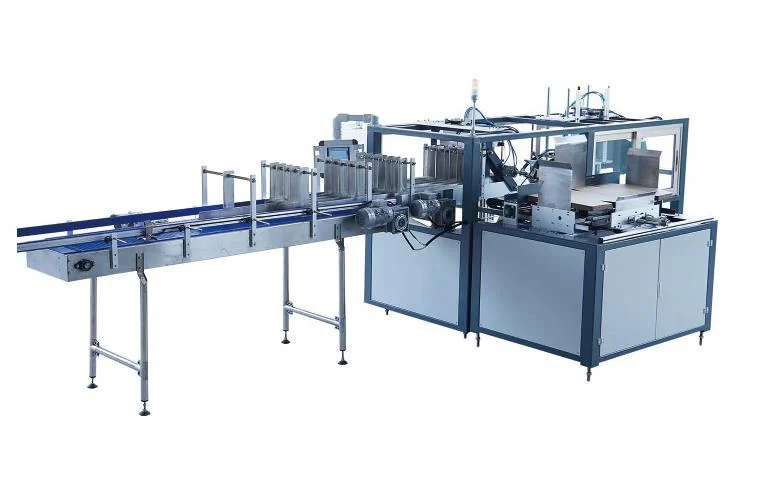
Ask Allot Tech to identify case forming/loading, closing technology, retained modules, material compatibility, utilities, controls and acceptance scope in writing. Use actual approved filled cases and linked joint evidence. The catalog packing image does not promise a tape or hotmelt module or universal carton range.
Define who approves board or adhesive substitutions and who verifies top and bottom closure under the relevant wait and handoff. An empty-case trial does not establish the behavior of the production bottle arrangement. Keep shipping and pallet requirements as separate agreed evidence, not an assumed consequence of local seal appearance.
- Case drawing, board lot and filled bottle arrangement
- Tape or glued-flap route with approved material lots
- Forming, loading, sealing and transfer machine identities
- Joint-location photos with matched inspection ages
- Stable, restart, wait and connected-handoff samples
- Closure criteria, substitutions and acceptance responsibilities
Questions buyers ask
Does tape that looks attached at discharge prove a case is ready to ship?
No. Verify the agreed wait and handling conditions and the actual filled case. Transport, stack and pallet qualification are separate requirements, not established by appearance at the sealer exit.
Will stronger tape always prevent cartons reopening?
Not necessarily. First locate flap alignment, actual contact or later handling failure and confirm the closure method. A taped and a glued-flap route need different approved material and machine reviews.
Related troubleshooting guides
Water filling machine low output
Water filling machine low output →Water bottle shrink-pack problems
Water bottle shrink-pack problems →Cap leaks after capping
Cap leaks after capping →Wrinkled or skewed bottle labels
Wrinkled or skewed bottle labels →Uneven fill levels and underfill
Uneven fill levels and underfill →Conveyor jams and tipping
Conveyor jams and tipping →Missing or unreadable date codes
Missing or unreadable date codes →Wet bottles after drying
Wet bottles after drying →Startup rejects after changeover
Startup rejects after changeover →Missing or extra bottles in packs
Missing or extra bottles in packs →Cap feeder jams and missing caps
Cap feeder jams and missing caps →PET bottle scuffing and scratches
PET bottle scuffing and scratches →Label web breaks and torn liners
Label web breaks and torn liners →Ask Allot Tech to review the evidence
Send your machine identification, package drawing and timed observations. State what is unknown so the proposed scope follows the actual problem.