
Bottled water production: solve one problem
Water Bottle Pallet Loads Leaning After Stacking: Find the First Moving Layer
A leaning finished pallet may begin with a poor pallet, an uneven first layer, a changing pack footprint or movement during later securing and transfer. A neat top view at the palletizer does not prove the load remains stable after the agreed wait and handoff.
Under an authorized safe observation plan, link the actual filled pack, pallet identity, layer pattern and load age across stacking, any supplied securing step and the next handoff. Find the first change in support or position. Isolate unstable loads; local appearance is not transport or warehouse-stack qualification.
Fix the load basis before comparing straight and leaning pallets
Keep approved pallet specification and condition, actual filled pack construction, footprint, layer count, pattern revision, layer-pad use and securing route where supplied. An empty-pack demonstration or a pallet of different dimensions is not the production load. Record retained conveyors and handling equipment explicitly.
Define the safe reference for layer position, the observation age and where the first offset appears. Separate pallet level, bottom-layer placement, pack deformation and whole-load movement. Do not approach, straighten or climb an unstable load to obtain a measurement; qualified personnel control access and disposition.
Illustration: 3 loads with the defined lean among 40 comparable observed loads equal 7.5%. Count affected loads separately from displaced layers and damaged packs, and state the checkpoint and age. This is not an allowable lean, rated pallet capacity, shipping result or Allot Tech performance.
Compare support at each connected handoff
Use matched load identities and the same agreed reference. If the first observation is only in dispatch, the evidence cannot tell whether the load left stacking correctly or changed during an earlier wait or transfer.
| First observed pattern | Evidence to preserve | Scope boundary |
|---|---|---|
| Pallet or first-layer support is already uneven | Actual pallet condition, first layer and fixed reference | Pallet input and layer-formation support |
| A specific layer changes shape before securing | Pack construction, pattern revision and linked layer observations | Pack support/formation and placement, not assumed wrapper cure |
| Load is aligned after stacking but changes at securing | Same load before/after the actual supplied securing route | Securing interface and approved package/load review |
| Aligned load changes after wait or transfer | Matched age, retained handoff and first displacement | Connected handling and separately required load qualification |
Retest without manually correcting a moving load
No robot path, gripper force, film tension, stacking height or load-capacity recipe is provided. Follow exclusion zones, isolation, lifting and OEM procedures. Never restrain a load by hand, enter a robot cell or use people as a stability test.
- 01
Preserve actual pack/pallet versions, pattern, original configuration and identified adverse load records.
- 02
Agree safe observation points, age, containment, quality disposition and the separate qualification requirements.
- 03
After required isolation, have responsible specialists review the first changed support boundary and authorize one permitted correction.
- 04
Repeat the same filled load and approved pattern through the originally failed stacking, securing, wait and handoff cases.
- 05
Review support, damaged packs and load disposition together; complete any separately agreed transport or storage qualification before release.
Make pack, palletizer and securing responsibilities explicit
An unsuitable pallet, unstable pack, misplaced layer and later handling event are different interventions. A taller or faster palletizer is not proof of a stable load. Preserve the first changed layer and actual handoff when deciding between material correction, service and equipment work.
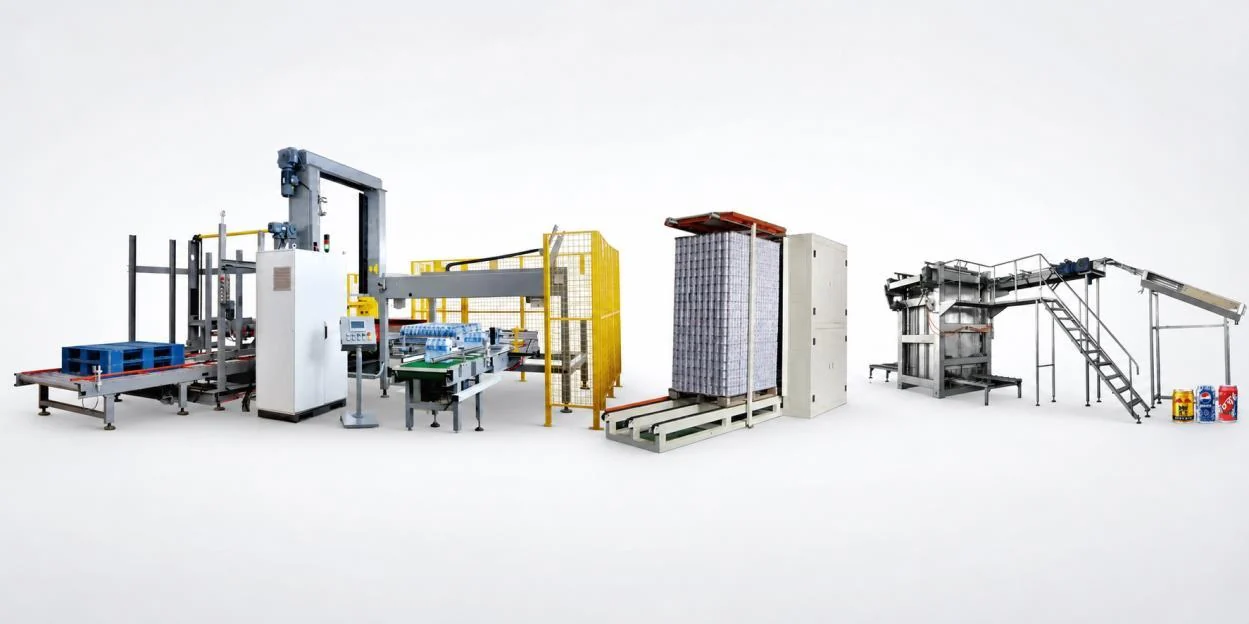
Send Allot Tech approved filled packs, pallet and pattern data plus matched load observations. Ask what layer formation, gripping, pallet feed, securing, transfer and acceptance functions are included or retained. Do not infer a stretch wrapper or universal pattern from a catalog palletizing picture.
Name who approves packaging substitutions, layer patterns, pallet condition and the downstream handoff. A short trial with different packs or without the securing/wait case cannot close the original failure. Keep shipping, warehouse stacking and load limits as separately confirmed requirements rather than silently treating local alignment as certification.
- Filled pack construction and actual dimensions
- Pallet specification, condition and load identities
- Approved pattern, layer count and pad revisions
- Stacking, securing and transfer equipment boundaries
- Matched layer-position observations with load ages
- Exclusion, disposition and separate acceptance responsibilities
Questions buyers ask
Does a straight load at the palletizer prove it is ready for transport?
No. Verify the agreed securing, waiting and connected handling cases. Required shipping or storage qualification remains separate from local alignment.
Will more stretch film always correct a leaning pallet?
No. Locate the first pallet, pack, layer or handoff change first. Any securing correction needs authorized package/load review and the same agreed retest conditions.
Related troubleshooting guides
Water filling machine low output
Water filling machine low output →Water bottle shrink-pack problems
Water bottle shrink-pack problems →Cap leaks after capping
Cap leaks after capping →Wrinkled or skewed bottle labels
Wrinkled or skewed bottle labels →Uneven fill levels and underfill
Uneven fill levels and underfill →Conveyor jams and tipping
Conveyor jams and tipping →Missing or unreadable date codes
Missing or unreadable date codes →Wet bottles after drying
Wet bottles after drying →Startup rejects after changeover
Startup rejects after changeover →Missing or extra bottles in packs
Missing or extra bottles in packs →Cap feeder jams and missing caps
Cap feeder jams and missing caps →PET bottle scuffing and scratches
PET bottle scuffing and scratches →Label web breaks and torn liners
Label web breaks and torn liners →Cartons reopening after sealing
Cartons reopening after sealing →PET bottle bases rocking after blowing
PET bottle bases rocking after blowing →Filling valves dripping between bottles
Filling valves dripping between bottles →Reject signal without physical bottle removal
Reject signal without physical bottle removal →Bottle sidewalls pulling inward after capping
Bottle sidewalls pulling inward after capping →Crooked or cross-threaded bottle caps
Crooked or cross-threaded bottle caps →Missing or intermittent bottle-rinser jets
Missing or intermittent bottle-rinser jets →Sleeve cutting drifts against the printed artwork
Sleeve cutting drifts against the printed artwork →Air pressure drops at the PET blow molder
Air pressure drops at the PET blow molder →Ask Allot Tech to review the evidence
Send your machine identification, package drawing and timed observations. State what is unknown so the proposed scope follows the actual problem.