
Filling interface · product-contact decision
Select Filling Valves from Product, Bottle and Hygiene Data
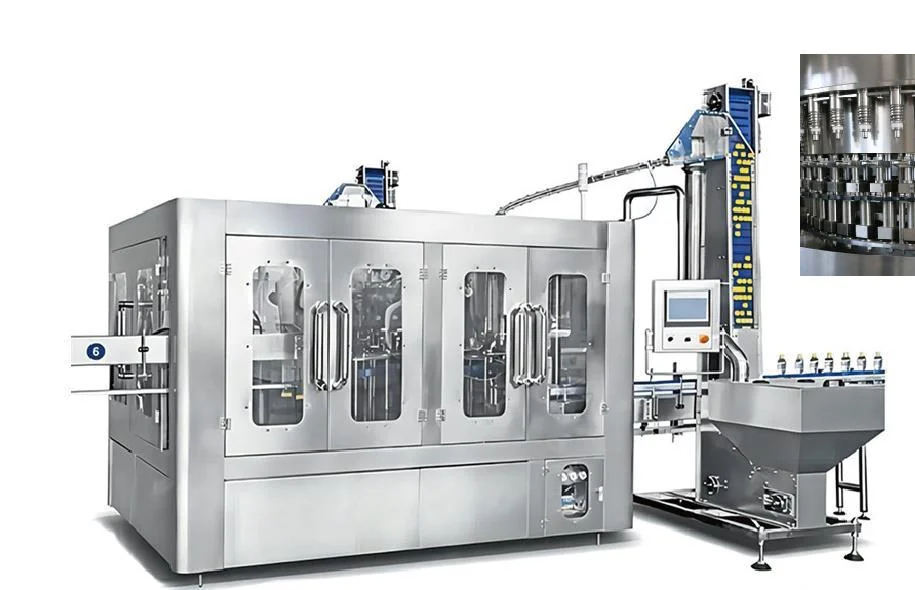
The valve arrangement must match the water, neck finish, bottle behavior, target fill condition, cleaning boundary and connected monoblock. A generic valve name is not a complete selection.
DIRECT ANSWER
What the buyer should decide
First distinguish how product enters the bottle from how filling is measured and stopped. Gravity or pressure describes the flow arrangement; level, volume or mass describes the control basis. Ask for both, plus the bottle-contact, venting, cleaning and test conditions.
| Decision field | Confirm | Why it changes the purchase |
|---|---|---|
| Fill basis | Level, volume and permitted tolerance basis | Controls test and rejection criteria |
| Bottle/neck | Finish, support, rigidity and format range | Controls centering and sealing contact |
| Hygiene | Product path, rinse or CIP boundary and drainage | Controls cleaning and verification |
BUYER DECISION WORKBENCH
Fill level, volume and mass are different control decisions
A method name is only useful when it tells you what is measured and what ends the fill. The following comparison is a buying framework, not a list of confirmed Allot Tech options.
| Control basis | What the supplier should explain | Buyer check |
|---|---|---|
| Level-based filling | How a level condition or sensing arrangement stops filling | Bottle internal geometry and headspace can affect the volume represented by a particular visible level |
| Volume-controlled filling | How a flow measurement or other metering method controls delivered volume | Confirm meter suitability, product properties, calibration, valve closing behavior and the format range |
| Mass-controlled filling | Whether mass flow or container weighing is used and how the result is controlled | Ask about tare or measurement basis, density conversion where volume is required, and test conditions |
| Timed filling | What stabilizes the delivered amount during the commanded time | Ask how changing supply conditions are controlled and how actual fills are verified |
Gravity feed is not the opposite of volumetric control: one describes the driving arrangement and the other the measured quantity. No method is universally best, and a level camera alone is not a calibrated net-content measurement.
BUYER DECISION WORKBENCH
Compare offers using the same fill-test record
Record the controlled bottle revision, product temperature and condition, target fill, accepted limits, test method, instrument identification, sample count and the machine operating condition. Keep startup, steady running and restart observations separate.
| Record | Why it belongs in the comparison |
|---|---|
| Individual fill results | An average alone can hide individual out-of-range bottles |
| Measurement basis and instrument | Level, volume and mass results must not be treated as the same measurement |
| Valve or station identity, where available | Supports investigation of a repeated pattern without assuming its cause |
| Rejected bottles and interruptions | Connects fill consistency to accepted output rather than nameplate speed |
| Product accounting | Distinguishes product inside accepted bottles from rejects, flushing and other losses |
Illustrative product-accounting example: an average 0.8 mL above a chosen reference across 20,000 bottles puts an additional 16 L into those bottles. This is not a recommended fill offset, legal tolerance or permission to reduce the approved fill specification; it excludes all other process losses.
REQUIRED INPUTS
Prepare the evidence before selection
Missing fields should remain marked as open rather than converted into assumptions.
- Treated-water specification
- Bottle and neck drawings
- Fill volume and level requirement
- Bottle temperature and rigidity
- Required output on each format
- Cleaning and sanitation expectation
TRADE-OFFS
Make the choice visible
Every option changes the machinery, operating work or project boundary.
Higher nominal speed
May require tighter bottle control and a different number of valves.
Wider format range
Adds adjustment, recipes and validation conditions.
More automated cleaning
Reduces manual work while changing piping, controls and documentation.
PURCHASING RISKS
Do not let these gaps hide in the quotation
Carry every unresolved item into clarification and contract documents.
- Quoting from BPH alone
- Assuming every neck finish uses the same contact parts
- Leaving drainability outside FAT
- Testing with a bottle different from production
WORK SEQUENCE
Move from data to a controlled next action
- 01
Approve product and bottle data.
- 02
Define fill acceptance criteria.
- 03
Review the proposed valve and product path.
- 04
Confirm cleaning and changeover boundaries.
- 05
Test with approved containers and water.
BUYER QUESTIONS
Answers to common bottled-water machinery searches
Use these answers to prepare the next supplier question; final configuration remains project-specific.
Is gravity filling the same as fill-level control?
No. Gravity describes how product is driven into the bottle, while level, volume or mass describes a measurement/control basis. Ask the supplier what ends the fill and how the result is verified.
Does the same visible fill height mean every bottle contains the same volume?
Not necessarily. Internal bottle geometry, deformation and the measurement conditions matter. Agree a method that checks the required quantity on the actual container; do not assume a visual level check establishes it.
How should I compare filling accuracy claims?
Compare the same product, bottle revision, target, individual acceptance limits, instrument/method, operating condition and sample record. A headline average or a different manufacturer's machine rating is not evidence for your proposed configuration.
Technical descriptions are selection guidance. Final machine, capacity, material, component, interface, utility and service details must be confirmed in the project proposal.
Content reviewed:
NEXT PURCHASING ACTION
Match the filling configuration to the controlled bottle.
Send water, bottle, neck, fill and cleaning data for written confirmation.