
Automation decision · task-by-task comparison
Compare Automatic and Semi-Automatic Water Bottling Machinery
Automation should remove a defined handling, quality or continuity constraint. A semi-automatic line can be appropriate at selected volumes, while a fully connected line needs stable containers, utilities, controls and trained maintenance.
DIRECT ANSWER
What the buyer should decide
List every operator task from bottle supply to final pack. For each task, record cycle time, ergonomic risk, inspection need, error recovery and required staffing. Automate the constraints that materially affect output or quality.
| Decision field | Confirm | Why it changes the purchase |
|---|---|---|
| Semi-automatic | Manual loading, transfer or packing around selected machines | Lower integration depth with higher labor dependence |
| Automatic core | Connected filler, labeler, packer and conveyors | Requires balanced speeds and interlocks |
| Higher automation | Automatic bottle supply, inspection and pallet handling | Requires stronger controls and maintenance capability |
BUYER DECISION WORKBENCH
Compare automation at each machine handoff
Ask each quotation to mark the operator work that remains. Automatic filling does not mean that empty-bottle supply, cap replenishment, pack removal or pallet movement is automatic.
| Production task | Manual or semi-automatic boundary to record | Automatic scope to verify |
|---|---|---|
| Empty-bottle supply | Who loads, orients and transfers purchased bottles? | Unscrambler or blower transfer, conveyor and shortage response; bottle formats must match. |
| Rinsing, filling and capping | Who presents containers and removes filled bottles? | Connected monoblock, cap delivery, transfers and upstream/downstream signals. |
| Labels and consumables | Who replenishes labels, caps, film and cases, and how often? | Selected feeding and warning functions; replenishment remains assigned work unless explicitly automated. |
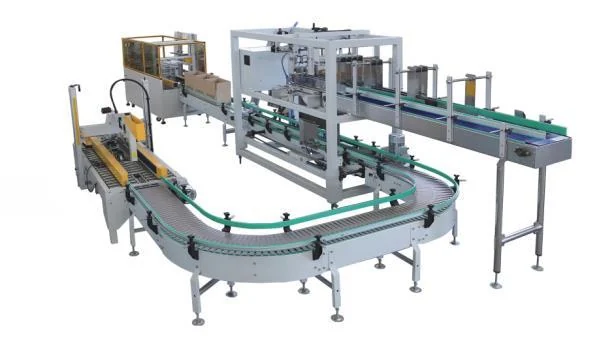
| Secondary packing | Who collates bottles, forms the pack and removes it? | Film or case packer, required forming/sealing or shrinking modules and discharge handling. |
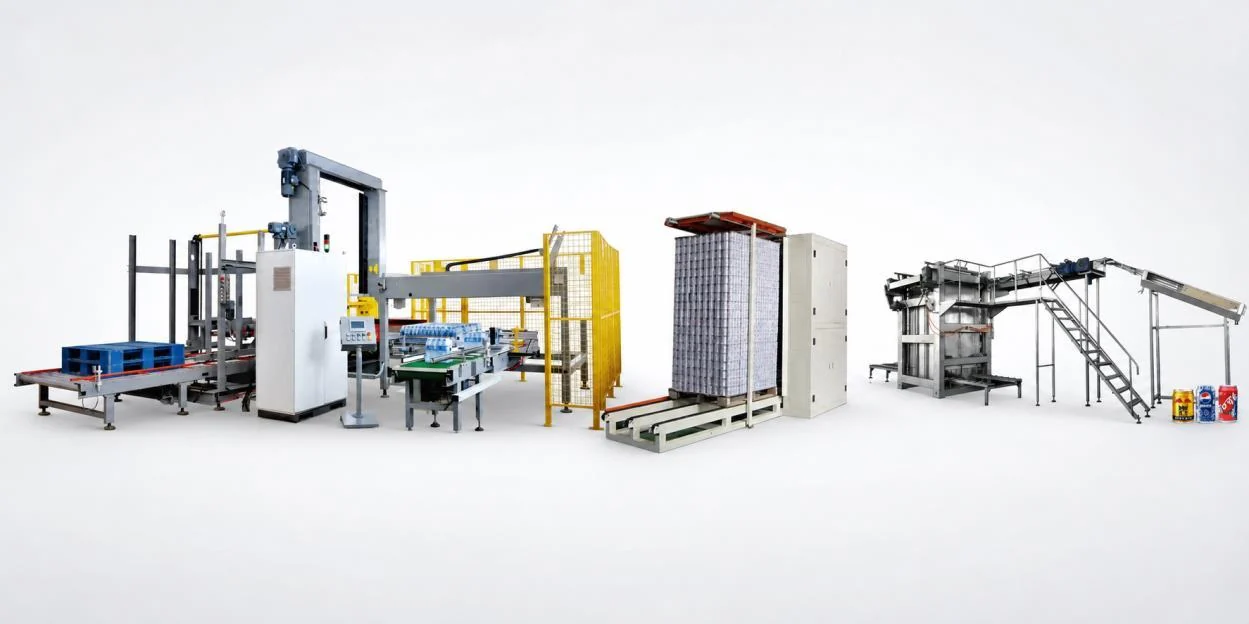
| Pallet handling and exceptions | Who moves packs, changes pallets and handles a stopped line? | Palletizing and conveying scope, guarded access and an agreed recovery responsibility. |
- Request a normal-running task list and a separate changeover/recovery task list.
- Compare the complete proposed scope at the same bottle, pack and saleable-output requirement.
- Do not convert this table into a worker-count guarantee; staffing needs a site-specific safe work assessment.
BUYER DECISION WORKBENCH
Check the pack interval before automating the filler
Illustrative planning arithmetic: a target of 5,000 bottles per hour in six-bottle packs requires 5,000 / 6 / 60 = 13.89 packs per minute, or one completed pack every 4.32 seconds. These are demand conversions, not a recommended manual work pace.
| Illustrative input | Calculation | What the buyer should investigate |
|---|---|---|
| 5,000 bottles/hour; six bottles/pack | 13.89 packs/minute; 4.32 seconds/pack | Can the full pack-forming and removal process sustain the required flow? |
| Hypothetical eight-second complete pack cycle | 60 / 8 = 7.5 packs/minute; 2,700 bottles/hour | This ideal no-interruption ceiling is already below the example demand. |
| Two people or parallel positions | No automatic doubling assumption | Check shared equipment, material replenishment, interference, safe handling and the actual work sequence. |
| Automatic packer proposal | Compare verified output for the same pack | Include pack discharge, changeover, consumable supply and line-control interfaces. |
The eight-second cycle is hypothetical, not a measured Allot Tech case. Breaks, rejects, replenishment, ergonomics and interruptions can reduce actual output. Use a representative trial and qualified workplace assessment before assigning staffing.
REQUIRED INPUTS
Prepare the evidence before selection
Missing fields should remain marked as open rather than converted into assumptions.
- Required output by SKU
- Available operators per shift
- Manual task cycle times
- Bottle and pack stability
- Utility reliability
- Maintenance skill and spares plan
- Expansion target
TRADE-OFFS
Make the choice visible
Every option changes the machinery, operating work or project boundary.
Manual flexibility
Operators can handle variation but may limit consistency, ergonomics and sustained output.
Connected automation
Reduces selected labor tasks while increasing interface and recovery requirements.
Phased automation
Preserves capital flexibility when future elevations, signals and space are reserved now.
PURCHASING RISKS
Do not let these gaps hide in the quotation
Carry every unresolved item into clarification and contract documents.
- Buying automation without naming the labor task
- Ignoring jam recovery and changeover work
- Assuming fewer operators means no technical staff
- Adding a fast machine to a slow manual stage
WORK SEQUENCE
Move from data to a controlled next action
- 01
Map current or planned tasks.
- 02
Measure the constrained operations.
- 03
Select the automation boundary.
- 04
Define exception handling.
- 05
Reserve future mechanical and control interfaces.
BUYER QUESTIONS
Answers to common bottled-water machinery searches
Use these answers to prepare the next supplier question; final configuration remains project-specific.
What is the difference between automatic and semi-automatic water bottling machinery?
The difference is the remaining operator work for loading, transfer, inspection, packing and recovery, not merely the control panel on one machine.
Can a semi-automatic water bottling line be upgraded later?
Possibly, if the installed machines, layout, transfer elevations, controls and utilities can accept the proposed automatic stages. Confirm compatibility and modification scope before buying; an upgrade is not guaranteed by the original automation label.
How many operators does an automatic water bottling line need?
There is no reliable universal headcount. List bottle and cap replenishment, label or film changes, inspection, packing, pallet movement, changeovers and fault recovery, then establish staffing from the actual layout, safe work assessment and representative production trial.
Can manual packing limit an automatic water filler?
Yes. Compare the required pack interval with the measured packing process, including replenishment, transfer, checks and interruptions. A fast filler cannot overcome a downstream operation that consistently removes bottles more slowly.
Technical descriptions are selection guidance. Final machine, capacity, material, component, interface, utility and service details must be confirmed in the project proposal.
Content reviewed:
NEXT PURCHASING ACTION
Automate the named bottleneck.
Send output, staffing and pack data to compare a semi-automatic, automatic or phased scope.