
Format decision · returnable versus one-way bottle flow
Compare 5-Gallon and Small PET Bottled Water Lines
This comparison covers a returnable 5-gallon container route and a one-way small PET bottle route. Container size alone does not decide whether it is returnable: a one-way large-bottle project needs its own equipment review. Start with the actual bottle lifecycle, then compare preparation, filling, closure and finished-pack handling.

DIRECT ANSWER
What the buyer should decide
Decide whether containers return for reuse or arrive new for each fill. A returnable route needs an agreed receiving, rejection, decapping and washing scope; a one-way PET route needs purchased empty bottles or in-house blowing. Compare saleable liters, container counts and downstream handling on the same operating basis.
| Decision field | Confirm | Why it changes the purchase |
|---|---|---|
| 5-gallon route | Returned container inspection, decapping, washing, filling and non-spill closure | Controls hygiene and heavy-container handling |
| Small PET route | Preform or bottle supply, fast monoblock filling, labeling and secondary packing | Controls bottle making and high-count handling |
| Mixed plant | Separate container paths with shared approved utilities where suitable | Requires clear sanitation and traffic boundaries |
BUYER DECISION WORKBENCH
Compare the equipment paths, not only the filler
Treat the following as a purchasing scope checklist. Final washing and sanitation methods require a qualified process assessment; this guide does not prescribe a cleaning recipe.
| Machine boundary | Returnable large-container route | One-way small-PET route |
|---|---|---|
| Container arrival | Receive and inspect returned containers; define rejection and segregation | Receive approved empty bottles or make bottles from approved preforms. |
| Before filling | Assign cap removal, external/internal washing, rinse and drainage equipment as required | Assign bottle handling and the approved bottle-preparation step; in-house blowing is a separate supply choice. |
| Filling and closure | Confirm support for the filled-container load and the actual neck/closure pair | Confirm bottle support, filling and capping for each lightweight bottle format. |
| After filling | Assign closure checks, coding, labeling or sealing and large-container transfer | Assign labeling/coding, pack collation, shrink or carton packing and conveyors. |
| Equipment interfaces | Separate incoming used-container movement from the prepared-container path | Match bottle presentation and line speed from bottle supply through the final pack. |

BUYER DECISION WORKBENCH
Compare equal water volume without equating the machines
Illustrative demand comparison using an 18.9 L fill volume selected for this example and a 0.5 L retail bottle. Replace both volumes with the actual labeled fill. This is not a universal definition of a five-gallon container or a machine-output guarantee.
| Illustrative case | Product-volume calculation | Container or pack handling |
|---|---|---|
| 200 large containers/hour at 18.9 L | 200 x 18.9 = 3,780 L/hour | 200 containers and closures per hour, before losses or downtime. |
| 0.5 L bottles carrying the same volume | 3,780 / 0.5 = 7,560 bottles/hour | 37.8 times as many containers at the same product liters/hour. |
| Six-bottle packs for the 0.5 L route | 7,560 / 6 / 60 = 21 packs/minute | The packer and its discharge must be assessed on the chosen pack basis. |
| Treatment and site services | 3,780 L/hour is net product only | Do not reuse this as raw-water intake or total process-water demand; account separately for treatment recovery and other uses. |
Equal product volume does not make the capper, washer, conveyor, labor or packing scope equivalent. Compare both routes at the same accepted-output boundary and operating calendar.
REQUIRED INPUTS
Prepare the evidence before selection
Missing fields should remain marked as open rather than converted into assumptions.
- Target market format
- Returnable or one-way bottle policy
- Bottle material and approved samples
- Daily liters and delivery model
- Washing and sanitation requirement
- Closure and final-pack definition
- Available plant area and utilities
TRADE-OFFS
Make the choice visible
Every option changes the machinery, operating work or project boundary.
Returnable 5-gallon
Reuses containers but adds collection, inspection, washing and large-bottle handling.
Small PET
Supports retail pack formats but adds bottle supply, high-count labeling and packing.
Both formats
Broadens the offer while creating two distinct equipment and operating paths.
PURCHASING RISKS
Do not let these gaps hide in the quotation
Carry every unresolved item into clarification and contract documents.
- Comparing barrel per hour directly with small-bottle BPH
- Applying PET handling assumptions to returnable containers
- Ignoring returned-bottle condition and traceability
- Using one layout for incompatible traffic flows
WORK SEQUENCE
Move from data to a controlled next action
- 01
Choose the product format.
- 02
Map the container lifecycle.
- 03
Define washing or bottle-making scope.
- 04
Normalize output in liters and saleable units.
- 05
Build separate machinery and hygiene boundaries.
BUYER QUESTIONS
Answers to common bottled-water machinery searches
Use these answers to prepare the next supplier question; final configuration remains project-specific.
Is a 5-gallon water line the same as a larger PET bottle line?
Not automatically. A returnable 5-gallon project needs receiving inspection, cap removal and a validated washing process as well as filling and closure. A one-way large PET bottle project follows a different preparation path. Confirm reuse policy and bottle material instead of choosing from volume alone.
How should 5-gallon and small PET line capacity be compared?
Use the actual liters per container and the same output boundary: containers per hour multiplied by fill volume gives product liters per hour. Also compare container and pack handling, because equal liters can require very different numbers of bottles, caps, labels and packs.
Can one machine fill both returnable 5-gallon containers and small PET bottles?
Do not assume this from a broad filling-volume claim. Container support, neck and cap geometry, preparation, washing, transfer and handling loads differ. Obtain a documented machine-specific format range and representative test evidence.
Representative machinery views
Compare the machinery form before selecting the project scope
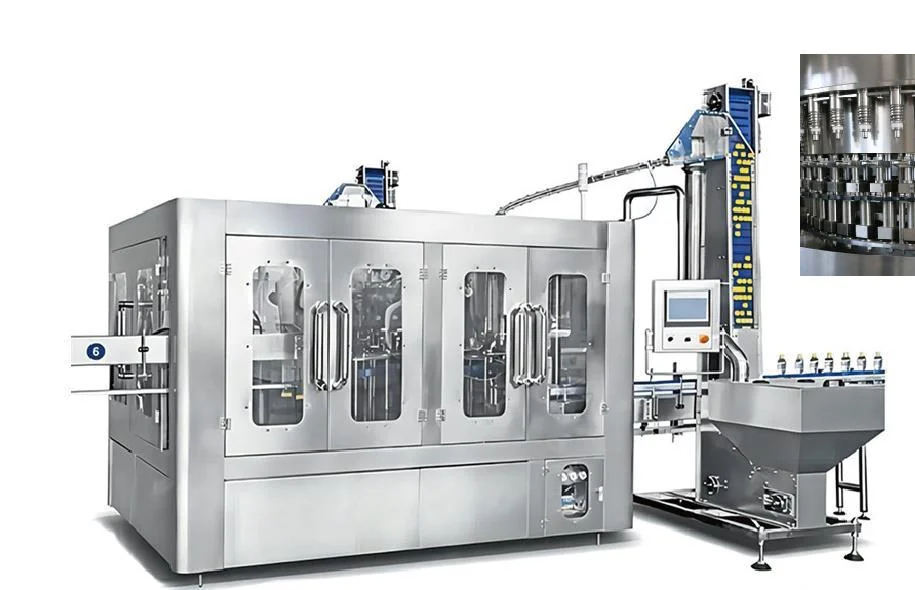
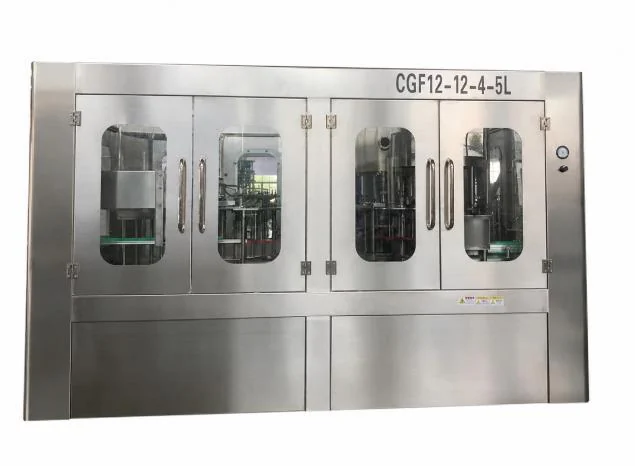
Technical descriptions are selection guidance. Final machine, capacity, material, component, interface, utility and service details must be confirmed in the project proposal.
Content reviewed:
NEXT PURCHASING ACTION
Start with the container lifecycle.
Send the bottle format, daily liters and distribution model for a format comparison.