
Large-bottle intent · format-specific selection
Select 3-15L Bottled Water Machinery from the Large-Bottle Format
Three-to-fifteen-liter bottles sit between small PET formats and returnable five-gallon barrels. Their mass, rigidity, neck, cap and handling behavior require a format-specific machinery review.
DIRECT ANSWER
What the buyer should decide
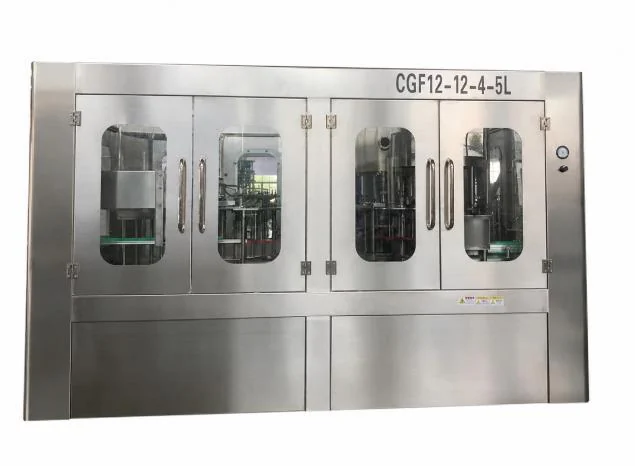
The catalog distinguishes a 3-15 L rotary water 3-in-1 machine from a 3-10 L linear water 3-in-1 machine. Their output and actual format compatibility need project confirmation. The separate piston filler on the same page has a 200-1,000 ml stated fill range and must not be treated as a 15 L machine.
| Decision field | Confirm | Why it changes the purchase |
|---|---|---|
| Container | Volume, material, neck, handle, rigidity and filled mass | Controls transport and support |
| Filling/closure | Monoblock or linear basis, cap and hygiene requirement | Controls product-contact machinery |
| Downstream | Label, code, carry method and secondary pack | Controls finished-format handling |
BUYER DECISION WORKBENCH
The catalog separates 3-15 L rotary and 3-10 L linear machines
Page 20 of the Allot Tech Beverage Bottling Catalog 2026 shows three separate equipment references. Read each caption with its own machine. The two large-format 3-in-1 arrangements have no published output figure on that page; the neighboring piston-filler specification must not be applied to either.
| Equipment on page 20 | Published container or fill scope | How to use the reference |
|---|---|---|
| Rotary bottle-water 3-in-1 | 3-15 L bottle category; output requires project confirmation | Evaluate the actual bottle, neck, cap, filled mass and transfer arrangement. |
| Linear bottle-water 3-in-1 | 3-10 L bottle category; output requires project confirmation | Do not treat 15 L compatibility as covered by this reference. |
| Separate automatic piston filler | 200-1,000 ml stated pouring volume on this separate machine | It is not evidence of a 3-15 L filling range or a capacity rating for the other two machines. |
These are catalog descriptions, not current availability or a confirmed quotation. A one-way large bottle and a returned 18.9 L container follow different preparation and handling tasks even when both are called large bottles.
BUYER DECISION WORKBENCH
Compare the primary machine arrangement for the actual large bottle
Compare the machinery arrangement after choosing the correct catalog reference. Page 20 distinguishes large-format rotary and linear 3-in-1 equipment; its separate piston filler is not a 3-15 L option. A modular arrangement outside those references requires its own documented offer.
| Arrangement to evaluate | What may be combined or separated | Use this route when |
|---|---|---|
| Large-bottle monoblock | Bottle washing or rinsing, filling and capping functions share one connected frame | The approved bottle and closure can be supported through every station and a compact integrated route fits the project. |
| Separate linear equipment | Bottle preparation, linear filling and closure application can be quoted as distinct machines | The container handling, sanitation boundary, format plan or layout supports a modular linear arrangement. |
| Multiple 3-15L formats | Either arrangement with a documented set of guides, supports, recipes and change parts | Do not assume every arrangement covers 3-15 L: the catalog linear 3-in-1 reference is 3-10 L. A broader proposed range needs a separate documented configuration. |
| Returnable five-gallon route | Dedicated returned-container inspection, decapping, washing, filling and closure equipment | Use the separate five-gallon decision path rather than assuming the 3-15L arrangement accepts returnable barrels. |
- Ask the offer to name bottle feed, wash or rinse, filling, cap feed, cap application and discharge as separate scope lines.
- Provide filled-mass and stability data as well as nominal bottle volume.
- Confirm handle, grip, neck and base features at every transfer.
- Test each quoted format with its own parts and recorded setup.
REQUIRED INPUTS
Prepare the evidence before selection
Missing fields should remain marked as open rather than converted into assumptions.
- Dimensioned bottle and neck drawings
- Approved bottle and cap samples
- Filled mass and bottle rigidity
- Required output by format
- Label and code position
- Pack or manual-handling method
TRADE-OFFS
Make the choice visible
Every option changes the machinery, operating work or project boundary.
Monoblock arrangement
Combines washing, filling and capping while requiring controlled bottle geometry.
Linear filling
Can suit selected large formats but changes footprint and transfer logic.
Multiple bottle sizes
Adds market flexibility and change-part, recipe and test requirements.
PURCHASING RISKS
Do not let these gaps hide in the quotation
Carry every unresolved item into clarification and contract documents.
- Applying small-bottle conveyor assumptions
- Testing only an empty container
- Ignoring handle or sidewall deformation
- Omitting finished-bottle manual handling
WORK SEQUENCE
Move from data to a controlled next action
- 01
Approve bottle and cap revisions.
- 02
Choose the filling and closure basis.
- 03
Map handling in every bottle state.
- 04
Define label and final pack.
- 05
Run format-specific FAT checks.
BUYER QUESTIONS
Answers to common bottled-water machinery searches
Use these answers to prepare the next supplier question; final configuration remains project-specific.
Is 3-15L bottled water machinery the same as a five-gallon line?
Not necessarily. Bottle mass, returnability, washing process, neck and cap, handling and target output can require different machinery and transfer arrangements.
What large-bottle data should be sent for a quotation?
Send bottle and neck drawings, cap samples, filled mass, rigidity, output, label position and final handling or pack requirements.
Representative machinery views
Compare the machinery form before selecting the project scope
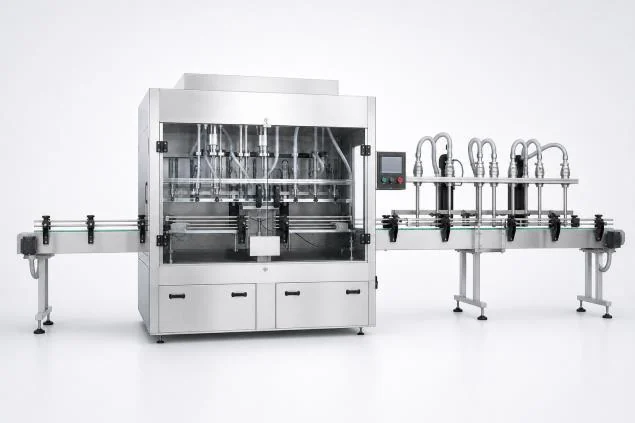

Technical descriptions are selection guidance. Final machine, capacity, material, component, interface, utility and service details must be confirmed in the project proposal.
Content reviewed:
NEXT PURCHASING ACTION
Send the actual large-bottle format.
Attach drawings, samples, output and final-handling requirements for selection.