
Integration desk · Cross-machine fit
Check Machine Compatibility Before the Purchase Order
Two machines can have similar rated speeds and still be incompatible. Bottle presentation, elevations, transfer geometry, line states, utilities, safety and changeover responsibilities must be confirmed at every shared boundary.
DIRECT ANSWER
What the buyer should decide
A compatible machine pair needs more than matching BPH. Agree the actual container transfer, datum and elevations, rate/recovery behavior, control meanings, utility conditions and access, then close each item with a drawing or test owned by the relevant parties.
| Decision field | Confirm | Why it changes the purchase |
|---|---|---|
| Container boundary | Bottle/pack geometry, stability and orientation | Confirms physical transfer |
| Control boundary | States, signals, protocol and safety ownership | Confirms coordinated stop/restart |
| Utility boundary | Quality, pressure, flow and connection point | Confirms machines can operate at the site |
BUYER DECISION WORKBENCH
One compatibility record for each pair of machines
Start at the discharge of one machine and end at the receiving point of the next. A filler model, matching nominal speed or familiar control brand does not establish that the two machines will work together. Use a shared boundary record so mechanical, control and utility questions do not fall between suppliers.
| Boundary | Evidence from both sides | What closes the question |
|---|---|---|
| Bottle transfer | Direction, elevation datum, neck/body support, transfer opening and approved bottle drawing | A matched interface drawing and witnessed transfer of the agreed formats. |
| Rate and accumulation | Same-SKU operating rates, receiving behavior, buffer basis and stop/restart conditions | An agreed operating envelope and test of starved/blocked recovery. |
| Controls | Signal meaning, electrical characteristics or protocol, permissives and fault behavior | A reviewed signal list and qualified integration test; brand names alone are insufficient. |
| Utilities and drains | Connection points, required conditions, simultaneous duty and responsibility | A signed machine-specific schedule identifying buyer and supplier work. |
| Installation access | Current machine dimensions, service clearances, delivery/lifting route and adjacent equipment | A reviewed layout and installation method, not the catalog footprint alone. |
BUYER DECISION WORKBENCH
Example: a transfer mismatch remains open until the interface is agreed
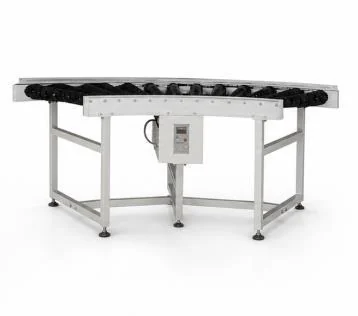
Illustrative procurement record: an existing conveyor drawing states a discharge elevation of 1,000 mm, while a proposed receiving interface is documented at 1,100 mm using the same floor datum. The 100 mm difference identifies an unresolved interface, not a permitted adjustment or an instruction to raise either machine.
- Record the two drawing revisions, datum, measurement conditions and responsible reviewers.
- Ask for an approved transition or installation proposal that also addresses bottle support, available length, guards and access.
- Document which party supplies, installs and tests the agreed solution.
- Keep the item open until revised drawings and the agreed transfer test meet the acceptance basis.
This example is not a measured site condition or a mechanical design. Physical modifications, structural support and safety validation require qualified project review.
REQUIRED INPUTS
Prepare the evidence before selection
Missing fields should remain marked as open rather than converted into assumptions.
- Approved bottle/cap/label/pack data
- Machine interface drawings
- Elevations and line direction
- Signal and safety matrix
- Utility schedules
- Changeover and operator plan
TRADE-OFFS
Make the choice visible
Every option changes the machinery, operating work or project boundary.
Standard interface
Simplifies coordination only when both suppliers use the same definition.
Custom adapter
Can solve a physical mismatch but adds verification and spare-part needs.
One integrator
Reduces handoffs but responsibilities still need to be written.
PURCHASING RISKS
Do not let these gaps hide in the quotation
Carry every unresolved item into clarification and contract documents.
- Checking only BPH
- Using outdated drawings
- Leaving field wiring and software undefined
- No owner for cross-supplier FAT issues
WORK SEQUENCE
Move from data to a controlled next action
- 01
Name each machine boundary.
- 02
Attach current interface evidence.
- 03
Classify open questions.
- 04
Assign one response owner.
- 05
Verify during FAT and site integration.
Technical descriptions are selection guidance. Final machine, capacity, material, component, interface, utility and service details must be confirmed in the project proposal.
Content reviewed:
NEXT PURCHASING ACTION
Build the interface register.
Send the upstream and downstream machine data with the container and utility basis.