
Water-type intent · treatment boundary
Separate Mineral-Water and Purified-Water Machinery Decisions
Mineral water and purified water can use similar bottles and downstream packaging while requiring different treatment decisions. The equipment train must follow the verified source water and target product, not the marketing name alone.

DIRECT ANSWER
What the buyer should decide
Obtain a current laboratory analysis and define the required finished-water specification. Review which constituents must be removed, controlled or retained, then confirm pretreatment, membrane or filtration stages, disinfection, storage and sanitation boundaries.
| Decision field | Confirm | Why it changes the purchase |
|---|---|---|
| Source evidence | Chemical, microbiological and seasonal raw-water data | Controls treatment risk |
| Target water | Required composition and regulatory/product basis | Controls removal and retention decisions |
| Process boundary | Pretreatment, membranes, disinfection, storage and sanitation | Controls the machinery train |
REQUIRED INPUTS
Prepare the evidence before selection
Missing fields should remain marked as open rather than converted into assumptions.
- Accredited raw-water analysis
- Target finished-water specification
- Source variability and temperature
- Required production flow
- Recovery and reject-water constraints
- Storage and sanitation plan
TRADE-OFFS
Make the choice visible
Every option changes the machinery, operating work or project boundary.
More removal stages
Can strengthen purification while changing recovery, energy and remineralization needs.
Selective filtration
May retain desired constituents but depends on verified water chemistry and barrier design.
More storage
Buffers production while increasing sanitation and residence-time control.
PURCHASING RISKS
Do not let these gaps hide in the quotation
Carry every unresolved item into clarification and contract documents.
- Selecting treatment from the product name alone
- Using an old or incomplete water analysis
- Ignoring concentrate or reject-water handling
- Treating the catalog train as a final process design
WORK SEQUENCE
Move from data to a controlled next action
- 01
Verify the source water.
- 02
Define the finished-water target.
- 03
Select treatment barriers.
- 04
Match flow and storage.
- 05
Confirm sanitation and monitoring.
BUYER QUESTIONS
Answers to common bottled-water machinery searches
Use these answers to prepare the next supplier question; final configuration remains project-specific.
Do mineral water and purified water need the same machinery?
They may share filling and packing equipment, but the treatment train depends on source-water chemistry, the target product and which constituents must be removed or retained.
Can a catalog process diagram replace a water analysis?
No. The diagram is a representative reference; treatment selection requires current raw-water and finished-water evidence.
Representative machinery views
Compare the machinery form before selecting the project scope
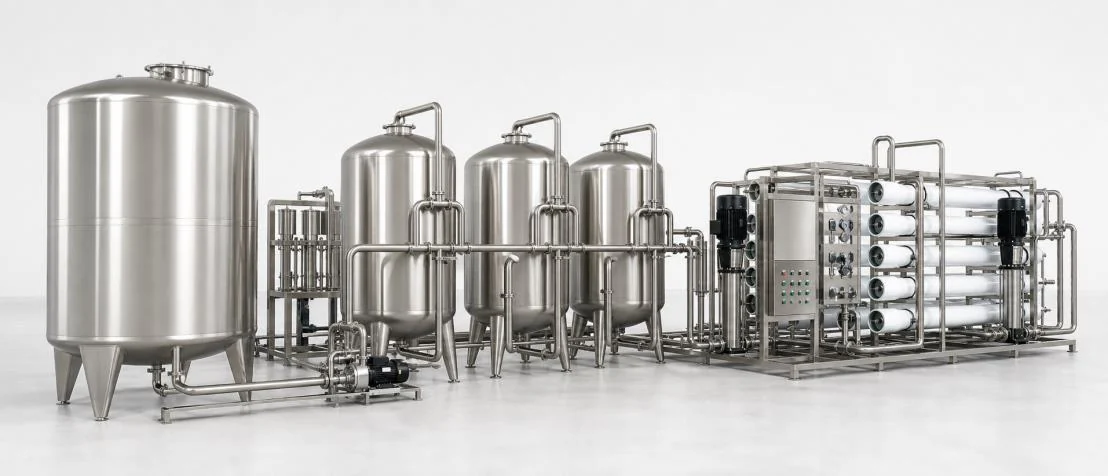
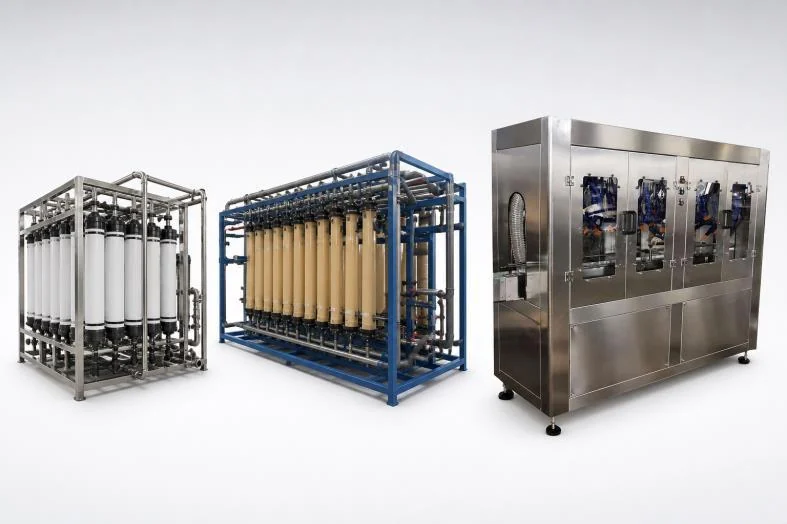
Technical descriptions are selection guidance. Final machine, capacity, material, component, interface, utility and service details must be confirmed in the project proposal.
Content reviewed:
NEXT PURCHASING ACTION
Start treatment selection with water evidence.
Send the raw-water report and target product specification for a process-scope review.