
Treatment technology intent · membrane selection
Compare RO and UF from the Contaminants and Product Target
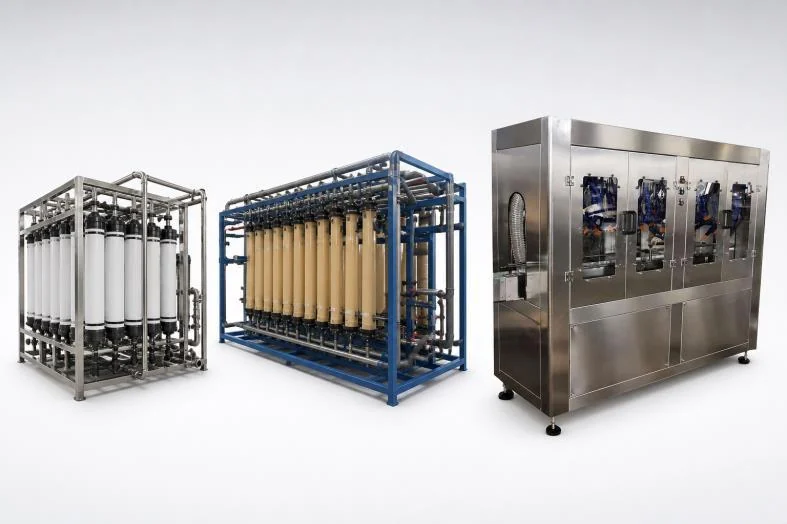
Reverse osmosis and ultrafiltration are not interchangeable labels. Their separation roles, feed requirements, recovery behavior, cleaning needs and effect on dissolved constituents differ.
DIRECT ANSWER
What the buyer should decide
UF and RO are not interchangeable labels. UF separates particles and larger material while many dissolved substances pass; RO is used when the design requires rejection of dissolved salts. Select the train from source-water evidence and the finished-water target, not from an assumed universal preference.
| Decision field | Confirm | Why it changes the purchase |
|---|---|---|
| Separation need | Dissolved ions, suspended solids and microbiological barrier | Controls membrane role |
| Feed condition | Turbidity, hardness, organics, temperature and fouling risk | Controls pretreatment and cleaning |
| Operating result | Permeate, reject, recovery, monitoring and disposal | Controls utility and owner scope |
BUYER DECISION WORKBENCH
Which treatment question are you trying to solve?
This is an equipment-selection comparison, not a prescription for making a particular water source safe. A qualified design may use multiple stages, including UF before RO.
| Project question | UF scope to discuss | RO scope to discuss |
|---|---|---|
| Particles and turbidity | Discuss membrane separation, feed variability, backwash and net availability. | Check pretreatment requirements before the RO stage; do not ignore suspended material. |
| Dissolved salts or conductivity target | Do not treat UF as a desalination step. | Request the membrane/process design basis for the actual dissolved-water composition. |
| Net production rate | Distinguish filtration-period flow from net output after backwash and downtime. | Separate permeate output from feed flow, concentrate and cleaning downtime. |
| Mineral composition target | Review which constituents must remain or change; do not infer product identity from the machine name. | Document the required finished-water composition and any separately designed downstream stages. |
| Acceptance | Verify relevant measured results at the agreed handover point. | Verify relevant measured results under the stated feed, temperature and recovery conditions. |
No universal salt-rejection percentage, microbial-removal guarantee or legal bottled-water classification is claimed here.
BUYER DECISION WORKBENCH
Compare two membrane quotations on one flow basis
Put both suppliers' quantities on the same page. An offer labeled 3,000 L/hour can refer to feed, product during operation, or net available delivery; these are different purchasing quantities.
- Record source-water report, design temperature and target composition.
- Mark every flow as feed, product, concentrate, backwash or net delivered output.
- Record effective production hours after planned cleaning and backwash.
- Identify tanks, pumps, instrument points and filler connection scope.
- Request acceptance evidence; do not infer performance from a catalog photograph.
REQUIRED INPUTS
Prepare the evidence before selection
Missing fields should remain marked as open rather than converted into assumptions.
- Complete raw-water analysis
- Finished-water target
- Required product flow
- Recovery and waste constraints
- Pretreatment concept
- Cleaning chemical and monitoring capability
TRADE-OFFS
Make the choice visible
Every option changes the machinery, operating work or project boundary.
RO removal
Addresses selected dissolved constituents while adding pressure, reject and scaling control.
UF barrier
Addresses selected particles and microorganisms without replacing dissolved-solids removal.
Combined train
Can assign different barriers while increasing equipment and sanitation complexity.
PURCHASING RISKS
Do not let these gaps hide in the quotation
Carry every unresolved item into clarification and contract documents.
- Selecting membranes from TDS alone
- Ignoring seasonal feed-water variation
- Quoting recovery without concentrate handling
- Omitting pretreatment and cleaning scope
WORK SEQUENCE
Move from data to a controlled next action
- 01
Define contaminants and target.
- 02
Set the membrane role.
- 03
Design pretreatment and recovery basis.
- 04
Assign monitoring and cleaning.
- 05
Confirm performance in the project proposal.
BUYER QUESTIONS
Answers to common bottled-water machinery searches
Use these answers to prepare the next supplier question; final configuration remains project-specific.
Does UF remove dissolved salts like RO?
UF primarily separates particulate and larger material, while many dissolved substances pass. It should not be selected as a desalination substitute for RO. Confirm the actual source composition, treatment purpose and finished-water requirements.
Can UF and RO be used in the same treatment train?
Yes, UF can be one pretreatment option before RO. Its suitability and the rest of the train depend on source-water evidence and the project design; it is not a mandatory or universally sufficient combination.
Is a 3,000 L/hour treatment label enough to compare equipment?
No. Identify whether the number is feed flow, product flow during operation or net delivered output, then compare design temperature, source-water conditions, recovery and cleaning/backwash availability.
Representative machinery views
Compare the machinery form before selecting the project scope
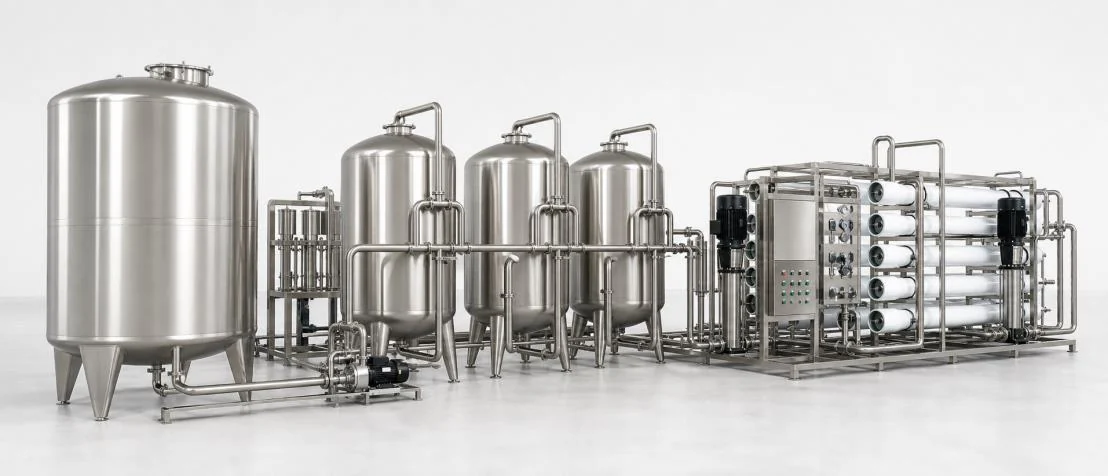
Technical descriptions are selection guidance. Final machine, capacity, material, component, interface, utility and service details must be confirmed in the project proposal.
Content reviewed:
NEXT PURCHASING ACTION
Select the membrane from verified water data.
Send the raw-water report, product target and flow basis for treatment review.