
Machinery stage 01 · Water preparation
CORE OR PROJECT-SPECIFIC
Water Treatment Machinery Selected from Raw-Water Evidence
Water treatment is not one universal machine. The equipment train must be defined from the raw-water analysis, treated-water objective, operating schedule, storage approach and the real demand of the filling section. A responsible quotation separates confirmed stages from stages that remain conditional.
Jump to quotation data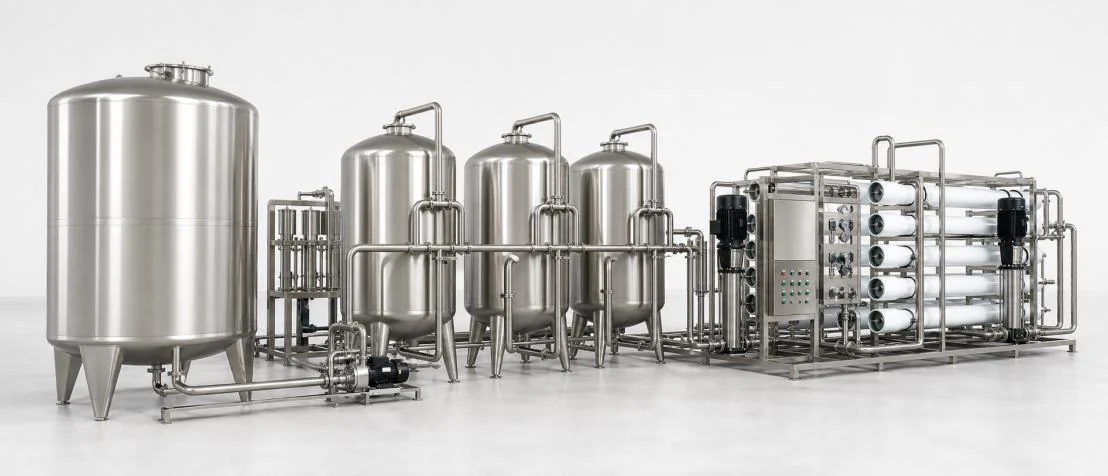
01 · QUICK ANSWER
What this machinery does and when it belongs
A treatment train conditions the available raw water for the agreed bottled-water target. It is normally required when the buyer is not receiving already compliant treated water. The final process cannot be selected responsibly without current raw-water and target-water data.
- Production stage
- Raw-water preparation before product storage and filling
- Selection status
- CORE OR PROJECT-SPECIFIC
BUYER DECISION WORKBENCH
Buy a defined treatment train, not an RO skid alone
A treatment proposal needs a source-water basis and an agreed finished-water target. The machinery boundary below separates equipment decisions from a generic liters-per-hour label.
| Purchase block | Evidence to request | Boundary to close |
|---|---|---|
| Raw-water intake and pretreatment | Current laboratory report, seasonal variation, temperature and available inlet conditions | Identify pumps, tanks, filters and any conditioning that the proposed membrane train requires. |
| UF or RO membrane stage | Purpose of the stage, design feed, expected net output, recovery and operating limits | Do not assume UF performs desalination or that any RO arrangement fits every source. |
| Product storage and delivery | Usable storage, connection size, delivery pressure/flow and production schedule | Define the tank, transfer pump, interconnecting piping and filler entry point. |
| Process monitoring | Agreed measurement points, instruments, sampling provisions and off-spec response | Document who verifies water quality; a machine specification is not water-quality approval. |
| Cleaning, backwash and drains | Defined cleaning/backwash scope, service-water use and drainage interfaces | Account for unavailable production time and separately assigned consumables/utilities. |
- Attach the same raw-water report and product target to every quotation.
- Ask which flow is guaranteed: feed, membrane product, or net water delivered after internal uses.
- List buyer-supplied tanks, field piping, wiring and commissioning work explicitly.
BUYER DECISION WORKBENCH
What a treatment offer should prove before purchase
Use a controlled duty point for the proposed equipment. A high nameplate flow measured under different feed or temperature conditions is not the same as accepted output on your project.
| Offer record | Required clarification |
|---|---|
| Design conditions | Source-water analysis revision, water temperature, target quality and relevant operating limits. |
| Mass and operating-time balance | Feed, product and concentrate/backwash quantities at the same stated operating point. |
| Delivery evidence | Net flow and quality measurement at the agreed handover point, including which internal uses are excluded. |
| Availability and service | Cleaning/backwash schedule assumptions, membrane and consumable identification, and maintenance access. |
| Acceptance record | As-tested feed, actual operating conditions, instrument basis, test duration and unresolved items. |
Final treatment design, sanitation and water-quality acceptance require qualified project-specific review. Catalog photographs show equipment families, not an approved treatment recipe.
02 · WHERE IT FITS
Follow the actual upstream and downstream product state
Raw water, verified analysis, feed conditions and site utilities
Water Treatment Machinery
Hygienic treated-water storage and controlled transfer to the filling machine
03 · BUYER DATA REQUIRED
Do not request a responsible selection without these inputs
- Raw-water source and recent laboratory analysis
- Target treated-water specification and local compliance basis
- Filling demand basis, production schedule and storage strategy
- Feed pressure, temperature and seasonal variation
- Available power, water, drainage and cleaning arrangements
- Factory space, access, floor loading and sanitary zoning
- Operator skill, chemical availability and maintenance capability
04 · MACHINE FUNCTIONS
Describe the work, not a marketing adjective
- 01
Remove or reduce the contaminants assigned to the confirmed process stages.
- 02
Condition feed water before a membrane stage when reverse osmosis is selected.
- 03
Provide hygienic storage and transfer without assuming tanks are included automatically.
- 04
Support disinfection through the confirmed UV, ozone or other approved method.
- 05
Expose pressures, flows, alarms and cleaning points required for operation and FAT.
05 · MAIN CONFIGURATION OPTIONS
Choose an option only when its condition applies
PROJECT-SPECIFIC
Pretreatment train
Media filtration, activated-carbon treatment, softening or cartridge filtration are chosen only where the analysis and downstream equipment justify them.
PROJECT-SPECIFIC
Membrane treatment
Reverse osmosis or another membrane stage changes recovery, reject-water, cleaning, instrumentation and storage requirements.
PROJECT-SPECIFIC
Disinfection and storage
UV, ozone, sanitary tanks, recirculation and transfer pumps must be assigned as one hygienic boundary.
06 · COMPATIBILITY REQUIREMENTS
Eight interfaces must agree at the machine boundary
A supplier response should point to the controlling drawing, schedule or test for each row.
| Interface | Confirmation required | Evidence state |
|---|---|---|
| Mechanical | Pipe sizes, connection standards, skid access, tank nozzles and drain points. | Confirm in drawing, schedule or test record |
| Container | Not a container-contact stage; its output must still support the selected bottle-filling process. | Confirm in drawing, schedule or test record |
| Product | Raw-water composition, treatment target, hygienic storage time and recirculation basis. | Confirm in drawing, schedule or test record |
| Electrical | Site voltage, frequency, motor duties, panel location and protection requirements. | Confirm in drawing, schedule or test record |
| Control signal | Tank levels, pump permissives, low-pressure trips, quality alarms and filler-demand signals. | Confirm in drawing, schedule or test record |
| Utility | Feed water, power, cleaning chemicals, instrument air where used, drainage and reject-water route. | Confirm in drawing, schedule or test record |
| Layout | Service aisles, membrane removal space, chemical handling, wet area and route to the filler. | Confirm in drawing, schedule or test record |
| Operator | Sampling, backwash, regeneration, membrane cleaning, sanitation and alarm response tasks. | Confirm in drawing, schedule or test record |
07 · SELECTION TRADE-OFFS
Record what the buyer is prioritizing
More treatment stages
Trade against measurable need and operating burden; record the buyer priority and evidence.
Higher automation
Trade against local troubleshooting capability; record the buyer priority and evidence.
Compact skid layout
Trade against access for membrane and pump service; record the buyer priority and evidence.
Larger storage buffer
Trade against sanitation control and residence time; record the buyer priority and evidence.
08 · COMMON QUOTATION OMISSIONS
Check what may sit outside the headline machine price
- Raw-water analysis and explicit design basis
- Feed or treated-water tanks and transfer pumps
- Membrane cleaning equipment and initial chemicals
- Interconnecting pipework, valves, supports and drains
- Water-quality instruments, calibration items and sampling points
- Commissioning consumables and operator training scope
09 · FAT INSPECTION POINTS
Trace the test back to approved project documents
- 01
Verify equipment identity against the approved process list and drawings.
- 02
Check wetted-material declarations and accessible fabrication details.
- 03
Run pumps, valves, instruments, alarms and interlocks on an agreed test loop.
- 04
Record available flow, pressure and quality indicators without converting a factory test into a site-water guarantee.
- 05
Close open items for chemicals, membranes, documents, spares and site connections.
10 · MAINTENANCE AND SPARE PARTS
Prepare categories before shipment; confirm exact parts from the final configuration
- Pump seals and service kits
- Filter cartridges and other confirmed consumables
- Instrument probes, calibration solutions or replacement sensors
- Valve seals, actuator kits and sanitary gaskets
- RO membrane or pressure-vessel spares only after the final design is confirmed
11 · NOT SUITABLE FOR
Reject the wrong application before discussing price
- Projects that expect a fixed treatment train without raw-water evidence
- Wastewater or industrial process-water duties outside the confirmed bottled-water scope
- Sites unable to provide the drainage, chemical handling or maintenance conditions required by the selected process
12 · INFORMATION NEEDED FOR QUOTATION
Send a machine-level request that can be answered
- Raw-water report and source description
- Target water requirement
- Required operating schedule and connected filler demand
- Site utilities and drainage
- Available room dimensions and access
- Preferred automation and documentation level
- Destination and local component constraints
Representative machinery views
Compare the machinery form before selecting the project scope
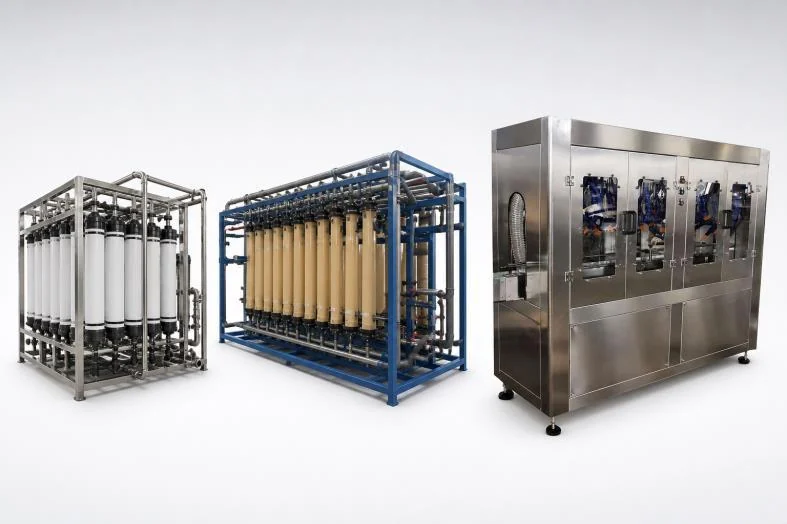
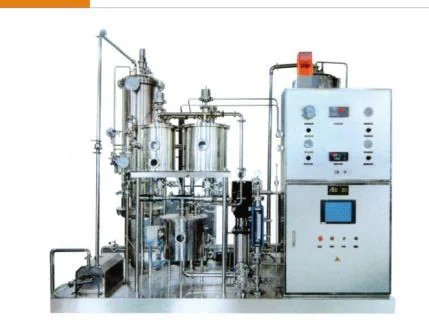
Technical descriptions are selection guidance. Final machine, capacity, material, component, interface, utility and service details must be confirmed in the project proposal.
Content reviewed:
NEXT PURCHASING ACTION
Match this machinery to the whole connected line.
Send the project-specific buyer data, adjacent machine details and open interfaces.